
- Published on

Eye contact can be a feature of social communication. Some people can find this very difficult. The following article suggests that just generally looking at the face of the person you are talking to is an ok substitution for eye contact. Read on for more information.
https://digest.bps.org.uk/2019/03/07/heres-a-simple-trick-for-anyone-who-finds-eye-contact-too-intense/
https://digest.bps.org.uk/2019/03/07/heres-a-simple-trick-for-anyone-who-finds-eye-contact-too-intense/
- Published on

Sleep is important to us in terms of our ability to function well while we are awake. More recent studies have confirmed that sleep is a time when our bodies repair and our minds consolidate what we have learned during the day. It is not unusual for me to be asked by parents about how to support their children and young people to establish good sleep habits. I thought I’d write a blog about my top tips for doing this.
Create a consistent daily routine:
Actually this starts in the morning. Make sure your child is waking up at the same or similar time each morning. Provide them with plenty of opportunities for exercise and fresh air during the day. Any focused or busy activities such as homework should be completed by the early evening. Provide your child with a predictable bedtime so that they know when they will be going to bed.
Create a food and drink plan that supports sleep:
Dinner should be finished at least an hour and a half prior to bedtime so that a full tummy won’t keep your child awake. As the evening moves on reduce consumption of liquids so that getting up to go to the toilet isn’t a problem.
Create a going to bed routine in the evenings:
Soon after dinner homework should be completed if it is not already done. A warm bath or shower and a change of clothes into sleep attire, brushing of teeth and so on will provide cues to everyone that it’s time to wind down and move into a different phase of the day. The warm bath or shower will elevate body temperature in anticipation of a drop of body temperature which signals sleep in our bodies. Following this should be a mixture of quiet and calming activities which could include some TV watching depending on the age of your child. About 30 minutes prior to lights out your child should be in bed and this is a time for a parent to read a story or for older children to read to themselves.
Create a bedroom environment that is conducive to sleeping:
Cover windows with curtains or blinds that block out as much light as possible. Remove or cover any devices which emit light. You may need to check after lights out as it can be hard to see illuminated buttons or switches during the day time. Ensure that their bedroom is cool and dry. If a room is too hot this will impact sleep quality. This is a personal issue so may require some experimenting with a range of temperatures and bed coverings. Keep bedrooms quiet in the evening. An exception to this might be a white noise creator. Some children find this will help them to fall asleep and may cover other noise which cannot be removed such as traffic noise from a nearby street.
My absolute top tip is this - keep devices out of the bedroom, and remove access to them at least 30 minutes prior to getting into bed. The blue light emitted by any device such as a laptop, TV, Ipad or phone stimulates our minds and will slow down the approach to sleep. Additionally the games children play on these devices are often very stimulating and will increase their arousal when they need to be reducing arousal. Older children may need to be able to access their devices to complete homework but parents should have discussions with them about developing good habits in relation to use of devices. Parents will need to model this behaviour themselves in order for their advice to be taken seriously by older children!
Create a consistent daily routine:
Actually this starts in the morning. Make sure your child is waking up at the same or similar time each morning. Provide them with plenty of opportunities for exercise and fresh air during the day. Any focused or busy activities such as homework should be completed by the early evening. Provide your child with a predictable bedtime so that they know when they will be going to bed.
Create a food and drink plan that supports sleep:
Dinner should be finished at least an hour and a half prior to bedtime so that a full tummy won’t keep your child awake. As the evening moves on reduce consumption of liquids so that getting up to go to the toilet isn’t a problem.
Create a going to bed routine in the evenings:
Soon after dinner homework should be completed if it is not already done. A warm bath or shower and a change of clothes into sleep attire, brushing of teeth and so on will provide cues to everyone that it’s time to wind down and move into a different phase of the day. The warm bath or shower will elevate body temperature in anticipation of a drop of body temperature which signals sleep in our bodies. Following this should be a mixture of quiet and calming activities which could include some TV watching depending on the age of your child. About 30 minutes prior to lights out your child should be in bed and this is a time for a parent to read a story or for older children to read to themselves.
Create a bedroom environment that is conducive to sleeping:
Cover windows with curtains or blinds that block out as much light as possible. Remove or cover any devices which emit light. You may need to check after lights out as it can be hard to see illuminated buttons or switches during the day time. Ensure that their bedroom is cool and dry. If a room is too hot this will impact sleep quality. This is a personal issue so may require some experimenting with a range of temperatures and bed coverings. Keep bedrooms quiet in the evening. An exception to this might be a white noise creator. Some children find this will help them to fall asleep and may cover other noise which cannot be removed such as traffic noise from a nearby street.
My absolute top tip is this - keep devices out of the bedroom, and remove access to them at least 30 minutes prior to getting into bed. The blue light emitted by any device such as a laptop, TV, Ipad or phone stimulates our minds and will slow down the approach to sleep. Additionally the games children play on these devices are often very stimulating and will increase their arousal when they need to be reducing arousal. Older children may need to be able to access their devices to complete homework but parents should have discussions with them about developing good habits in relation to use of devices. Parents will need to model this behaviour themselves in order for their advice to be taken seriously by older children!
- Published on
A website that I often recommend which has a treasure trove of resources to manage and understand anxiety is Hey Sigmund which is run by Karen Young, who is very active in providing support in this area.
https://www.heysigmund.com/
https://www.heysigmund.com/
- Published on
A reminder that everyone has moments of sadness and anxiety.
The link is to a fantastic youtube video that talks about emotions and helps children/young people to understand that mental health is similar to physical health and that everyone experiences difficult emotions at times. There are lots of great ideas for support. This one would be great to watch with your child/young person.
https://www.youtube.com/watch?v=DxIDKZHW3-E&w=840&h=473
The link is to a fantastic youtube video that talks about emotions and helps children/young people to understand that mental health is similar to physical health and that everyone experiences difficult emotions at times. There are lots of great ideas for support. This one would be great to watch with your child/young person.
https://www.youtube.com/watch?v=DxIDKZHW3-E&w=840&h=473
- Published on
When children find they are overwhelmed by emotions this poster gives some great ideas for managing them well. This is a great visual for supporting children with self-regulation.
https://3ppsychologies.com/2018/11/08/resource-diary-entry-35-regulation-coping-strategies/
https://3ppsychologies.com/2018/11/08/resource-diary-entry-35-regulation-coping-strategies/
- Published on

Growth and fixed mindsets seem to be buzz words of the moment. From business to education conversations about mindsets seem to be popular. Carol Dweck is the researcher credited with bringing this new way of thinking about success to our attention. She literally wrote the book on it, Mindset: The New Psychology of Success. Carol Dweck first published this book in 2006 and updated and republished in 2016. I spent some time this past summer reading Carol’s book and would highly recommend it to anyone interested in finding out more about mindsets. Mindsets are either growth or fixed and most people are a mixture of both growth and fixed mindsets depending on circumstances. A person with a growth mindset is much more likely, according to the research, to be successful and resilient in the long term than a person with a fixed mindset. A person with a growth mindset believes that if they engage with learning and work hard, they can be successful. A person with a growth mindset views mistakes as an opportunity to learn and develop while a fixed mindset person believes that they were born talented and therefore don’t need to work hard to learn.
Some key ideas are:
Check out the link below to view Carol herself speaking about mindsets in a Ted Talk. https://www.ted.com/speakers/carol_dweck
Some key ideas are:
- Effort is not everything, although it is important. Learning new strategies is key. It doesn’t matter how much you try, if a strategy isn’t right for you or isn’t appropriate for the task you are trying to complete.
- Other people are key for your success. Don’t be afraid to ask for help. Children may need help identifying the best people to help them.
- Avoid judging people. Some people with more resources do have an advantage. At times circumstances may prevent an individual from achieving.
- Rather than seeing the final product or the win as the reward, growth mindset allows us to see the process of improving or the journey to the final product or win as rewarding.
- Growth mindset does not mean everything that can be changed should be changed.
- It’s OK to accept some of our imperfections.
- Individuals need to be allowed to decide for themselves what they would like to change (or if they would like to change)
- Fixed mindsets lead to inferior learning strategies.
- While a fixed mindset says that early performance predicts future achievement a growth mindset says that you can learn and develop skills to become successful.
Check out the link below to view Carol herself speaking about mindsets in a Ted Talk. https://www.ted.com/speakers/carol_dweck
- Published on

To finish up my series of blogs on anxiety I’ve created a list of tried and true resources for you and your child/young person.
As an educational psychologist, I've used a number of resources to support my work and these are a few that I am happy to recommend. Not every resource will work for every person. If you don’t find it helpful or your child doesn’t seem to benefit from it then try something else.
As an educational psychologist, I've used a number of resources to support my work and these are a few that I am happy to recommend. Not every resource will work for every person. If you don’t find it helpful or your child doesn’t seem to benefit from it then try something else.
- Mindfulness apps:
- Smiling Minds (Australian, designed for schools, children as well as adults)
- Calm (American, designed for both children and adults, has some exercise videos)
- Headspace, (British, designed for both children and adults). These can be useful to help develop an awareness of the way thinking influences feelings, among other uses.
- Hey Sigmund, https://www.heysigmund.com/about/ (very comprehensive website focused on anxiety with a huge range of resources for a wide age range)
- 3P Psychologies, https://3ppsychologies.com/ (website covers more than just anxiety but is a treasure trove or useful resources)
- Helping your anxious child, second edition, Ronald Rapee, Ann Wignall, Susan Spence, Vanessa Cobham, Heidi Lyneham (excellent resource is you are facing persistent difficulties)
- Published on

What can parents do to help their young people to become better able to manage anxiety? Strategies to support your young person follow:
- Allow children to experience the change in their mood/feelings from baseline to the peak of anxiety and then the descending of the anxious feelings back to baseline. It’s great to provide reassurance and support but don’t act to remove the anxiety provoking experience unless it is unsafe not to do so.
- Normalise the experience of anxiety for children. Everyone experiences anxiety/worry. It often feels worse than the situation is.
- Acknowledge the reality of the strength of the feelings.
- Encourage and model talking about feelings. Sometimes children have difficulty talking about their feelings because they don’t have the language to describe their feelings. Parents can model this kind of talk by using labels for feelings. What are some of the labels we give to feelings?
- Play games with these ‘feeling’ words, for example charades, where one family member acts out a named feeling while the rest of the family guesses which feeling they are acting out. There are commercial games available which focus on the language of emotions and feelings.
- Link feelings with the way we are thinking. Behind every worried/anxious feeling is a thought.
- Talk about where in the body anxiety or worry is felt. At times our bodies may experience increased breathing rates, shallow breathing, urge to go to the toilet, feeling hot and/or sweaty, tears, aching stomach, trembling, blushing and others. Start by talking about where you feel anxiety. Encourage your child to talk about their experience. Some children may find it easier to show you on a soft toy or doll. Naming these experiences and talking about them helps us as adults understand what is going on for the child and we can share the thought that the child isn’t alone in their experiences.
- Using a scale. Scaling helps people to put their thoughts into context. You can use a 1 – 10 scale with 1 representing relaxed and 10 very worried. Talk about a situation that your child may be worried about and encourage them to select a number that represents how worried they are. A good question to follow up with is what we could do to help you feel just a little bit better. If your child says they are a 7 on the scale, then what is one thing that could make you be reading to move to a 6. Brainstorm possible ideas.
- Encourage and model realistic thinking with your child. When your child is worried or anxious it is easy for them to jump to the worst-case scenario or to catastrophize the situation. Help them to think through the reality. Even in very difficult situations solutions can be found and a way forward identified. Remind your child that their thinking is creating the feelings and that thinking can be used to manage the feelings and find solutions to the situations they are concerned about. When appropriate model your own problem-solving process when faced with a challenge.
- Praise your child’s management of what they perceive as difficult situations. Keep the focus on what they can do rather than delving into the difficulties.
- Published on

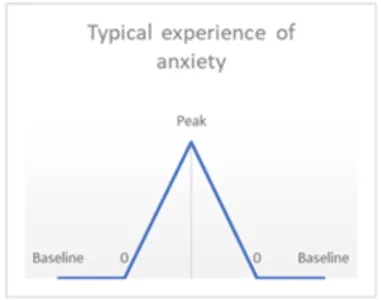
Let’s talk about anxiety. Today’s article will discuss the typical experience of anxiety, fear or worry that everyone encounters. If you are concerned that anxiety is more than every day, I have some further information at the end of this article.
First up let’s get our minds into anxiety mode. Think about a near miss situation when you were driving a car. How did you feel during and immediately after this situation? Did you get back in your car the next day? Did anything change in your driving behaviour?
Anxiety is something that our thinking mind creates which is reflected in our bodies. From an evolutionary perspective anxiety is a useful adaptation because it helped to keep us safe from sabre tooth tigers and other hazards in the environment. The anxiety helps us to consider, plan and strategize how to keep ourselves safe. In our modern world there are certainly things which anxiety legitimately helps us to negotiate safely.
The picture above illustrates the typical pathway for anxious feelings. We start at a baseline of feeling confident and able to manage a situation without concern. Something triggers a rise in anxiety which will reach a natural peak and then begin to subside until we reach baseline again. Problems commonly occur when we interrupt the process of:
When should parents seek professional help for anxiety?
· If your child’s worries/anxiety significantly interfere with the child or family daily functioning and routines.
· The worries/anxiety are not age appropriate.
· The worries/anxiety persist across an extended period (longer than 6 months).
Questions to ask about your situation to help decide whether further support is needed.
· Is anxiety stopping my child from doing the things they want or need to do?
· Do most children of the same age also have the same fear or worry?
· How severe is my child’s reaction? (sourced online from the Macquarie university centre for emotional health).
Next month I’ll talk about some of the helpful things parents and teachers can do to support young people to manage anxiety.
First up let’s get our minds into anxiety mode. Think about a near miss situation when you were driving a car. How did you feel during and immediately after this situation? Did you get back in your car the next day? Did anything change in your driving behaviour?
Anxiety is something that our thinking mind creates which is reflected in our bodies. From an evolutionary perspective anxiety is a useful adaptation because it helped to keep us safe from sabre tooth tigers and other hazards in the environment. The anxiety helps us to consider, plan and strategize how to keep ourselves safe. In our modern world there are certainly things which anxiety legitimately helps us to negotiate safely.
The picture above illustrates the typical pathway for anxious feelings. We start at a baseline of feeling confident and able to manage a situation without concern. Something triggers a rise in anxiety which will reach a natural peak and then begin to subside until we reach baseline again. Problems commonly occur when we interrupt the process of:
- becoming more alert or aroused
- facing the situation that is triggering the anxiety/fear/worry
- allowing the anxiety to subside as we manage the situation.
When should parents seek professional help for anxiety?
· If your child’s worries/anxiety significantly interfere with the child or family daily functioning and routines.
· The worries/anxiety are not age appropriate.
· The worries/anxiety persist across an extended period (longer than 6 months).
Questions to ask about your situation to help decide whether further support is needed.
· Is anxiety stopping my child from doing the things they want or need to do?
· Do most children of the same age also have the same fear or worry?
· How severe is my child’s reaction? (sourced online from the Macquarie university centre for emotional health).
Next month I’ll talk about some of the helpful things parents and teachers can do to support young people to manage anxiety.
- Published on

Friendship can be defined as pleasure in the company of others, it is a reciprocal relationship in that support is expected to flow both ways. Friendships give children a context to learn social skills, they learn about themselves and other people, they provide emotional and learning resources and they provide models for subsequent relationships.
If you are worried about your child’s friendships, there are a few things you can do. It’s important to start by considering whether your child is someone who requires many friends. Some more introverted children prefer few friends compared to other more extroverted children. Some children also establish closer friendships with peers outside of the school setting, possibly even on-line. Keep in mind that the virtual world is just like the real world and children will need appropriate levels of parental supervision and support.
The following things may seem obvious to parents who have had many years to develop their social skills, but it is worth thinking about whether your child is able to do the things expected of a friend? Does your child’s body language invite others to interact? Do they know how to establish appropriate eye contact? Do they have an open posture and an inviting facial expression? Does your child sound friendly, expressive and pleasant? What is your child’s tone, pitch, rate and volume? Does your child have a range of appropriate greetings and introductions they can use in different situations? Do they know how to start conversations? Do they have a range of simple questions or topics that they can talk about? When they engage in a conversation, do they know how to answer a question, do they take turns allowing the other person to speak? I frequently use the analogy of a dance when talking about parenting. It’s important to be there to provide support when needed but equally important to stand back a little to allow them to give it a go alone. Ensure that there is the right balance between under and over involvement of parents.
Provide praise to your child as they learn and practice their skills. Offer opportunities for them to self-reflect on how things went. Keep a growth mindset. Any difficulties should be a learning opportunity. What could we do differently? Who could help?
If you are worried about your child’s friendships, there are a few things you can do. It’s important to start by considering whether your child is someone who requires many friends. Some more introverted children prefer few friends compared to other more extroverted children. Some children also establish closer friendships with peers outside of the school setting, possibly even on-line. Keep in mind that the virtual world is just like the real world and children will need appropriate levels of parental supervision and support.
The following things may seem obvious to parents who have had many years to develop their social skills, but it is worth thinking about whether your child is able to do the things expected of a friend? Does your child’s body language invite others to interact? Do they know how to establish appropriate eye contact? Do they have an open posture and an inviting facial expression? Does your child sound friendly, expressive and pleasant? What is your child’s tone, pitch, rate and volume? Does your child have a range of appropriate greetings and introductions they can use in different situations? Do they know how to start conversations? Do they have a range of simple questions or topics that they can talk about? When they engage in a conversation, do they know how to answer a question, do they take turns allowing the other person to speak? I frequently use the analogy of a dance when talking about parenting. It’s important to be there to provide support when needed but equally important to stand back a little to allow them to give it a go alone. Ensure that there is the right balance between under and over involvement of parents.
Provide praise to your child as they learn and practice their skills. Offer opportunities for them to self-reflect on how things went. Keep a growth mindset. Any difficulties should be a learning opportunity. What could we do differently? Who could help?